Showing posts with label Joko Diaz. Show all posts

Thursday, March 1, 2012

Cesar Montano's "Hitman" - Inferiorly Channeling Pen-ek Ratanaruang's "Headshot"


During a short, albeit relaxing getaway from work sometime November last year, I chanced upon Pen-ek Ratanaruang’sHeadshot” in Bangkok’s Lido Cinema. It ran alongside the Cannes’ winning apocalyptic drama, “Taking Shelter” and Julia Leigh’s surreal “Sleeping Beauty”. In the movie, Tul (Jayanama Nopachai), a hitman sustains a near fatal head wound that leaves him in a coma for 3 months. Fast forward to three months hence, Cesar Montano’sHitman” opens in local cinemas with dejavu’ish plot that had me thinking, “I know I’ve seen this before”. Unfortunately, that’s where comparison ends.

Ben Murillo (Cesar Montano) is sidetracked for years after miraculously surviving a gun shot in the head. Left for dead, Ben was comatose for 7 years, but he is gradually recovering. His memory has been spotty since then. One day, he meets Gina (Sam Pinto), a popular model who, unknown to Ben, is the daughter of Amando (Ricky Davao), a casuistic character who runs an illegal ring of activities that range from white slavery and drugs to gambling. At the very heart of this business is Tomas (Phillip Salvador), the head assassin. Tomas is tasked to eradicate any impediment, including Ben, a promising assassin under Tomas’ care. When Ben tells his superiors of his intention to retire and leave the group, the big boss decides to obliterate Ben.

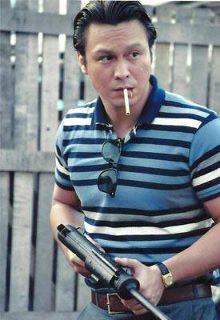
Meanwhile, there is much internal strife within Amando’s “kingdom”. Tomas is demanding P10 million from Amando for an earlier deal they’ve supposedly agreed upon. But Amando is defiant. Moreover, the web of deceit reaches Alvin (Mark Herras), Amando’s much abused adopted son. When Amando’s other son Mike (Joko Diaz) gets killed in the crossfire, another set of henchmen have been tasked to take Gina who’s estranged from her father. But Gina fortuitously harbors an indecent stash of dirty money hidden somewhere so she conveniently becomes a target.

When Ben hooks up with flirty Gina, he gets thrown back into the same quagmire he once escaped from; the same people who had him assassinated. And this time, he has to protect her to his death. He once lost his pregnant wife to the same people. Never again!


Cesar Montano was always a competent actor. After his Seiko days, his career choices were note worthy. But "Hitman" is a baffling cinematic comeback. Despite his character being a former assassin - who should have a dark, brooding persona (after all, his pregnant wife died and slices of his memory have been staved off his consciousness) - but Montano's Ben is curiously chirpy and upbeat, posturing as though he runs with the hip and yuppy crowd! In fact, he even mutters cringe-worthy english phrases: "See you, guys!" This is how a hitman talks? There's more where that comes from, but we've noticed Montano's awkward penchant for intermittent Anglican lines (think: Piolo Pascual, Jericho Rosales, Diether Ocampo).

Posturing for effect works when you're relatively juvenile, but when you're pushing 50, such tack becomes gag-worthy! I suddenly remembered his "Bandila" interview with Boy Abunda where he would painfully dive into the Queen's tongue, forthwith stalling when he loses grip with the language. In the same interview, he lovingly refers to his mother as "his" - "his prayer", "his dream", "his intention". Bandila, as far as I know, is a news magazine show spoken in the vernacular. Ba't kasi ipinipilit ang 'di kaya, di ba? Speaking Tagalog is never a fault, and running around town to promote an action picture in fractured English can only do your promotion harm! I remember Montano's "Singing Bee" days where even pronunciation of the song's English titles are an afflictive; sheer agony! Desperation to speak the Queen's language should never be caught on camera! Do your practice behind the cam, lest you want your audience nauseating over your despondency!


Sam Pinto looks immaculately beautiful all throughout. Her early scenes look relaxed. She is, after all, portraying the role of a model - so how hard can that be? This is promising since in her past movies, she has always delivered mind-bogglingly flat characterizations. It's clear she needs to do something about her thespic acumen - or the lack of it. As the movie unravels to its hundred-and-one twists, we realize that Pinto is in dire need of help. In a scene where gun men break into her place, as Ben fights the hooded henchmen, Gina (Pinto) comes out of the bathroom looking awkward, not to mention oblivious to the gun shots heard all over the place. She tentatively calls: "Ben? Nasaan ka?" Yet all we witness is a
blunt affect, an emotion-wanting facial expression if you will. She didn't look perturbed of the bullets flying around - or her appliances breaking and crashing down the floor. Yeah, forget those bullets! She needed Ben to dry her wet hot bod! Her stark
cluelessness was a spectacle in itself. She personified blank emotionality where there should be fear, concern, and even histrionic demeanor!

AFTER THE ELABORATE EXPLANATION

This is repeated in a scene where Mark Herras, playing the avenging brother, delivers a 7-minute spiel about "taking charge" in front of sister Gina who's crying invisible tears. After the line, Herras declares: "Akin na ang kaharian n'yo!" Everyone understood what he was saying. I did! It was retribution and ambition coming into place. Then Pinto replies: "Ano ang ibig mong sabihin?" I almost fell off my chair! After a seven-minute explanation, she obviously didn't get a morsel of epiphany from Herras' confession? And it showed in Pinto's face! She was baffled to bits! Poor, poor girl!


Phillip Salvador does better as the head hitman Tomas who trained Ben. It was inevitable that the "teacher" and "student" would eventually dive into a scuffle. This was cinematic conjecture. After all, Salvador's mano-a-mano with Montano would convey gravitas - in an action showdown between the two formidable action-drama actors, each one as competent and iconic as the other! Unfortunately, the artistic choices for the staging of the climactic shootout comes off with an uneven and misguided strategem. Suddenly, Montano decides to infuse ill-advised humor, one-sided and flat as his leading lady's expression:

During the shootout, Ben would say: "Pinapakain pa ako ng alikabok ng matandang yun."

"Nakakatakbo pa ang matandang 'to eh may rayuma!"

"Ang daldal ng lolo ah."

"Akala ko tuhod lang ang mahina, pati pala mata!"

Yet all these lines were mere passing of gas where Tomas was concerned. In fact, he never acknowledged any of them. And there's something about badly delivered humor without a reciprocating audience, right? It drives the salient point that it's falling on deaf ears because it just isn't funny! How do you reconcile someone with a massacred family and a bullet in his skull delivering jovial lines as though he's in a sitcom?

This discrepancy of character is similarly evident in Phillip Salvador and Ricky Davao's characters where they play brothers. Phillip inconveniently calls Ricky "kuya"! Is anyone blind? Ricky maybe heavily built, but you can't deny Phillip's seniority where facial features are concerned. By at least a decade! His facial integument sags and his wrinkles abound!

Mark Herras looked alarmingly gaunt. It looked like a sea breeze could throw him down easily. He's cachectic and tuberculous. If he's gunning for the action genre, he would need to bulk up a bit - instead of looking like there's an on-going famine in the Philippines. In fact, I didn't realize it was Mark until the latter half of the film when he was finally given lines! When his character came out of his shell, he was emphatic, bearing pellucid motives. He understood where his character Alvin was coming from. That was good enough for me... as long as he doesn't use his brawn when there's none.


"Hitman" underlines a few of the reason why the action genre died a natural death. Like its predecessors, Director Montano's film is recklessly written, even incoherent in narrative structure. The story is derivative; the skill in film making unimpressive. Montano's action hero is an amalgam of characters that contradict with his past and present. In fact, you don't understand how he became as he has become. There's a palpable disproportion to the way he's depicted, making it easy not to empathize with him. Heck, I never even found myself sympathizing with Ben from start to finish. All I kept thinking was how he was able to enveigle Sam Pinto to do bath tub scenes and half a dozen of lip service with him!
Inspiring eh?

As for mirroring Ratanaruang's vision, it's better if we forget this connection all together. Someone's bound to deplorably suffer in comparison.


Tul, a hitman, sustains a bullet wound in the head in Pen-ek Ratanaruang's "
Headshot".


Pen-ek Ratanaruang's Headshot


Sam Pinto and Cesar Montano's constrained pairing. She speaks English, he speaks quack.


Cesar Montano postures like a yuppy action hero: "See you, guys!"


Tuesday, December 27, 2011

Asiong Salonga Story - The Land of Posturing Potbellied Gangsters


There are valid reasons why biopics are produced, the most common of which is to tell the story of a popular figure; the “real” one that explains his origin and motivations. Another is to demystify a persona steeped with preconceived notions; strip him out of hearsays and hyperbole; venture on this personality’s charm or notoriety, and understand why such personality fascinates the public.

One of these personalities was Nicasio “Asiong” Salonga.

Asiong Salonga (Jorge Estregan aka ER Ejercito) is an iniquitous mobster boss from Tondo who, in the late 40’s, lived a fast life with plenty of guns and a coterie of women. He was clannish and patriarchal of his townmates, yet implacable towards his enemies. People either feared or admired him. When he married Fidela (Carla Abellana), his grasp of the criminal underground burgeoned further. It helped that his brother, Domeng Salonga (Philip Salvador) was a well decorated, albeit highly regarded police officer. He became so influential that even political parties (he’s pro-Liberal Party) would compete for his good graces and ultimately, his endorsement. Asiong was also generous to the poor, earning him the moniker “Robinhood ng Tondo”.

But not everyone was pleased with Asiong’s rise. His main nemesis constituted a group of miscreants headed by Totoy Golem (John Regala) who wanted him “discarded” for good. After a series of retaliatory shootouts, Asiong was put in prison where he befriended a cellblock mayor (Jay Manalo) who helped hatch an escape. Unfortunately for Asiong, he was imprudent. He got caught. Not long after this, he was propositioned to foil an assassination plot against a local Liberal Party standard bearer who carried enough political heft to give him a parole.

Asiong reclaims his hold in the underworld mob, but had to contend with betrayals within his men. He learned of Erning’s (Baron Geisler) abusive streak. One day, Golem invites him for a conciliatory meeting, unaware that Erning has “jumped ship”. Would Asiong survive the plot?


Filmed in glorious black and white, this ambitious opus has the visual savvy reminiscent of Wong Kar Wai and vestiges of Jonathan Sela’s eye-popping camera work in “Max Payne”. But “Manila Kingpin – The Asiong Salonga Story”, a film not directed by Tikoy Aguiluz, is all gloss and cinematic posturing. The story is pretty trite and uninsightful. It offers a plot that might as well be another henchman’s story. There’s nothing distinct about its narrative. More importantly, it forgot to tell the story behind what we already know: Which family reared him? What made him who he became? We needed to understand the genesis of a mobster – but this wasn’t on the cinematic plate. Was it a problem explained by the very public altercation between director Tikoy Aguiluz (who did not direct this movie, let me be very clear) and the Laguna governor and executive producer? I doubt.

Whether it is Aguiluz’s 115 minute cut or Ejercito’s 150 minute copy, it is obvious that the problem is in the substance, casting and cinematic vision. Or should I offer it to be re-titled to “The Land of the Potbellied Gangsters”? The movie purports to re-introduce Asiong Salonga to a generation who has no idea of his name or nature. It intended to bring back the old-fashioned “Pinoy action movie” which has, thankfully, died a natural death. It intended to make Jorge Estregan a legitimate action figure and dramatic actor in one sweep, something that he never succeeded in his younger days. He was, after all, a starlet, riding in the coattails of his family’s ear-friendly surname. Did anyone remember him in films like “Mga Paru-parung Buking”, “Boy Tornado”, “Kumander Dante”, “Pepeng Kuryente”, and “Gapos Gang”? Didn't think so. Does anyone remember the governor star in a film called “Asiong Salonga: Hari ng Tondo” in 1990 (directed by Armando de Guzman, Jr.)? Why would you remake something that didn’t work the first time? The indomitable human spirit is sometimes nothing but a meaningless folly.


Jorge Estregan doesn't possess the charisma of Joseph Estrada or Rudy Fernandez who both starred as Asiong Salonga in 1961 and 1978 (Title: “Salonga”, co-starring his father, George Estregan) respectively. His signature expression is that of a scowl, and when he’s angry, it turns into a devilish gaze (“nanlilisik ang mga mata”), something that isn’t too different from “the scowl”. Even his declarative sentences feel like constipated ramblings. His foray into real emotions provokes somnolence. Carla Abellana is luminous, but watching her lock lips with the governor inspires goose bumps; it’s a gag-inducing sight. It’s like mixing turpentine and milk, then taking a swig. It’s a potently visceral sensation.

The film, conceived as an action opus, is populated by actors sporting Santa Claus bellies. Seasonal requirement, perhaps? But a genre has to follow a physical criteria to be believable – or did the gangsters of old Tondo really sport such watermelon guts? If these were to find itself in international exhibits, wouldn’t the audience question the use of such unfit actors for a slambang action? We should get Sharon Cuneta for a new "Darna" film, if that's the case.

Others in the cast are wasted in Ejercito’s shadow: Baron Geisler (who’s as nefarious here as his public persona), Amay Bisaya, Joko Diaz, Ronnie Lazaro, Yul Servo, Roldan Aquino, Ping Medina, John Regala, Philip Salvador, Dennis Padilla, Jay Manalo, et.al. The ladies are mere decorative habitues: Carla Abellana, JC Parker, Paloma and the beautiful Valerie Concepcion whose sophistication belonged to that era. Even Asiong explained the role of women in that era: “Dapat lagi kang maganda, malambing, at hintayin mo lang ang pag uwi ko.” Ouch. Don’t we have the right to impose the same? That he should look handsome, at least – if we’re to do what he said?


In one slow motion scene, Asiong charges into a compound filled with his nemesis, each one carrying heavy artillery. In the succeeding gun fight, he decimates 3 dozen armed thugs without even ducking or running for cover. He just took his stride forward, stood unflinchingly stiff, and fired his gun while bullets crossed his path. He came out unharmed. Talk about spectacular, right? Maybe he possessed the powers of Pepeng Agimat or Kumander Inggo?

DISPLACED MUSIC

In another scene, Asiong takes his wife Fidela to a club where we find the handsome Ely Buendia laboriously singing a “kundiman” – a song called “La Paloma”. This scene felt misplaced because haranas and kundimans required full-bodied voices a la Diomedes Maturan, while the iconic Buendia has thin pipes and nasal singing. You do wonder about such artistic choices.

The best part of the movie is the posturing of our protagonist. He stares like he’s ready to devour. He sports an attitude that belies calm and composure. If its attitude we want, its attitude we get… with the pot belly, of course! And not much else.


Totoy Golem (Regala) isn't happy with the competition.


Baron Geisler is Erning


Carla Abellana and Jorge Esregan


Compare Asiong Salonga and a Wong Kar Wai flick (with Tony Leung)


Mark Wahlberg as "Max Payne"


Faces of Asiong: Joseph Estrada and Rudy Fernandez