
Rocky Polotan and Tracy Fuentebella (Sam Concepcion and Tippy Dos
Santos) are a young couple who enjoy a loving relationship. But when the
latter finds out that she’s pregnant, they instigate a maelstrom of affliction that
places both of their families in a quandary. While Tracy’s folks flounder in
their affluent milieu, Rocky’s parents are persistently burdened by incoming
bills. Pol (Ogie Alcasid), Rock’s
father - a musician who has a single hit song to his name – subsists by giving
guitar lessons to the children in his neighborhood. He’s mostly frustrated and
uninspired by his misfortune. Rose (Eugene
Domingo), his wife, struggles with her catering service.
The day the Polotans visit the farm villa of the Fuentebellas for the “pamanhikan” (asking for Tracy’s hand in
marriage), the rudely gaping social discrepancy between the two families becomes
painfully apparent. While Tracy’s dad Nick (Gary Valenciano) seems to calmly take everything in stride, mom
Elaine (Zsa zsa Padilla) is
conflicted. She sees a vicious cycle in her daughter – and she doesn’t want
Tracy “to feel trapped in a loveless
relationship”. At least wait until you’re older, she suggests. But the
repercussions of having a child out of wedlock is a nagging concern for the
Fuentebellas, and a stigma they’d rather spare Tracy from. “Atin ang babae,” Nick would reason out.
Though Rocky is a board certified nurse, he is unemployed just yet. And Tracy’s
strait-laced grandfather (Jaime Fabregas),
a former military sergeant, isn’t compelled by tact or false civility to keep
his thoughts. Over lunch, he unravels them. He does not want Tracy to
wed Rocky who does not deserve his granddaughter.
Soon, insults are thrown around and fisticuffs ensue. The Polotans walk
out with contused faces and bruised egos. Rocky and Tracy’s impending wedding
is unceremoniously called off. What becomes of our star-crossed lovers? Is
there happy-ever-after in a musical narrative? Guess.
 |
| Syotang Pa-Class |
 |
| Doo Bidoo |
Writer and director Chris
Martinez concocts a delectable Romeo-and-Juliet tale by sumptuously utilizing
the music of Apo Hiking Society. This
cerebral exercise is so meticulously formulated that the songs of a generation –
so familiar that they’re almost prosaic, seasoned, and common place – suddenly gain context for a new generation
of music lovers. In fact, these songs feel like they’ve been written for the
given narrative. Moreover, you cannot deny the timelessness of these musical ouvre. You further realize that these were a few of the songs hummed to you
by your father; hymns of a lifetime once played on vinyl records now safely
tucked away in some decrepit basement.
What’s more impressive is how Martinez is able to exquisitely insinuate contemporary issues into his seemingly mundane musical romcom: unemployment and the diaspora of the modern immigrants (“Blue Jeans”: Sige kayod sa skwela at balang araw makikita nyo. Pagkatapos ng iyong paghihirap, ‘Di ka rin makakahanap ng trabaho); teenage pregnancy (“Batang Bata Ka Pa” – Nagkakamali ka kung akala mo na ang buhay ay isang mumunting paraiso lamang); class wars, homosexuality (“Mahirap Talagang Magmahal ng Syota ng Iba”), etc. “Blue Jeans” is particularly surprising because the concerns of the 70’s vividly resonate almost 40 years later. It makes you wonder if the lives of that generation aren’t all that different compared to ours. Why do we have similar concerns? Have social conditions deteriorated since the turn of the century?
What’s more impressive is how Martinez is able to exquisitely insinuate contemporary issues into his seemingly mundane musical romcom: unemployment and the diaspora of the modern immigrants (“Blue Jeans”: Sige kayod sa skwela at balang araw makikita nyo. Pagkatapos ng iyong paghihirap, ‘Di ka rin makakahanap ng trabaho); teenage pregnancy (“Batang Bata Ka Pa” – Nagkakamali ka kung akala mo na ang buhay ay isang mumunting paraiso lamang); class wars, homosexuality (“Mahirap Talagang Magmahal ng Syota ng Iba”), etc. “Blue Jeans” is particularly surprising because the concerns of the 70’s vividly resonate almost 40 years later. It makes you wonder if the lives of that generation aren’t all that different compared to ours. Why do we have similar concerns? Have social conditions deteriorated since the turn of the century?
Sam Concepcion sizzles with an
earnest performance that bristles with charm, pathos and urgency. Most singers
would have trouble with cinematic emotions, but impassioned Concepcion hits all the
right notes! In fact, it’s hard to consider this anything less than a career
high. Tippy Dos Santos is a great
cinematic find. She’s easy on the eyes, sings like a lark, and tempers her lines
with adequate verve and emotive skill. Ogie Alcasid shines in a surprisingly
restrained turn. I’ve never considered him in dramatic light, but Alcasid is a
revelation here. When he utters: “Kinahihiya
mo na lang ako lagi” or “Lahat tayo,
kailangan ng inspirasyon sa buhay”, your heart crumbles with palpable
affection.
Zsa zsa Padilla utilizes her pent-up frustrations here; a career-best. What I admire most is how consistently she tackles Elaine, a long suffering wife eternally patient and hopeful in a loveless marriage with a hubby who mostly ignores and disdains her presence. Her sedulous take of her character is nothing short of brilliant, and her singing is impeccable. In fact, her “Tuyo ng Damdamin” rankles with regret, you just want to whisk her off her agony. Eugene Domingo balances her fretful Rose with intermittently biting lines that sent me chuckling so loud. We all know someone who nags like that: “Default mode nya yan. Laging galit!” Gary Valenciano is a little tentative with his characterization. He defines his portrayal with large strokes fit for music videos. Fact is, this is his comeback film after almost 20 years of cinematic hiatus. Fortunately, he enjoys good chemistry with Padilla, so that's a plus!
Zsa zsa Padilla utilizes her pent-up frustrations here; a career-best. What I admire most is how consistently she tackles Elaine, a long suffering wife eternally patient and hopeful in a loveless marriage with a hubby who mostly ignores and disdains her presence. Her sedulous take of her character is nothing short of brilliant, and her singing is impeccable. In fact, her “Tuyo ng Damdamin” rankles with regret, you just want to whisk her off her agony. Eugene Domingo balances her fretful Rose with intermittently biting lines that sent me chuckling so loud. We all know someone who nags like that: “Default mode nya yan. Laging galit!” Gary Valenciano is a little tentative with his characterization. He defines his portrayal with large strokes fit for music videos. Fact is, this is his comeback film after almost 20 years of cinematic hiatus. Fortunately, he enjoys good chemistry with Padilla, so that's a plus!
 |
| Awit ng Barkada |
I do have issues about using non-singers in singing roles, but Eugene Domingo more than passes muster,
although she could have done a wee better in her “Di Na Natuto” duet with Alcasid. After all, paying homage to the
songs of a generation includes singing these songs beautifully. When, Dame Judi Dench, for example, performed
“Send in the Clowns” for her role in
Sondheim’s wistful “A Little Night Music”
at the Royal National Theatre in London, it was heartfelt, but I helplessly
looked for the beautiful melody. Melodies deserve to be sung as they were
written, not recited into a half-song. Anyway, Dench won the Olivier that year.
Domingo is clearly inspired, and it shows. Her “Awit ng Barkada” number with Frenchie
Dy (as BFF Lilibeth) and Sweet
Plantado (as BFF Vicky) was a touching tribute to friendship, I had to
control myself from shedding a tear because – heck! – the scene wasn’t
schmaltzy! But you see, beautiful numbers just make me cry (dramatic or
otherwise).
A considerable, albeit bittersweet side story involves Neil Coleta’s
Brent, Rocky’s closeted best friend who’s in love with him. Though his scenes inadvertently
provide humor, you can’t help but be taken by Brent’s emotional impasse. This
narrative string is so beautifully written, it deserves a separate movie of its
own. In fact, I am urging all the Pink Film makers to turn their attention to
this film for inspiration! This short narrative detour amounts so much more
than all of the Pink Films shown in 2011 combined! It is funny, empathetic and
insightful. It doesn't paint the gay man as hormonal, albeit sexual predators possessing the brain of a Hydra! An important scene here involved John Lapus
shedding a tear while Coleta dedicated his “Kaibigan”
song to Rocky – at a videoke bar! This understated and wistful vignette was a perfect finishing
touch to a cinematic Mona Lisa. It was just beautiful!
The narrative isn’t seamless. It’s guilty of “fast resolutions” common in romcoms. It
could have invested a little more time to write the gradual resolution or settlement
to Rock and Tracy’s dilemma, but then I understand the limitation of time
allotted for such flicks. In fact, I think I saw “Paano” in the credits, but the scene involving it didn’t make the
final cut. Needless to say, one of my favorite numbers was the “Blue Jeans” dance routine involving a huge
crowd in La Salle Dasmarinas. It was just kinetic, and reminded me of some
scenes from Jeric Soriano’s “Hotshots” (which also starred Gary Valenciano).
HOW APO DEFINES FILIPINOS TO OTHERS
We are a very musical nation. I remember my traveling cousin relate an anecdote about a Canadian backpacker he met in Vietnam last February (2012). The Canadian guy has a Filipina girlfriend who would take him to karaoke nights with fellow Filipinos in Vancouver. His favorite: “Ewan”! And just before my cousin could dismiss this as pure hearsay, this white man suddenly lurches into “Mahal kita, mahal kita, hindi ‘to bola…” This is a guy who doesn't have clue on who Danny Javier, Jim Paredes and Buboy Garovillo are. Yet their musical legacy encompasses race and geography. Who can say that the APOs are mere historical anamnesis? We deserve our songs encapsulated and documented in films like “I Do Bidoo Bidoo”. These songs tell our stories, and we can only be grateful for the endless pleasure they bring.
We are a very musical nation. I remember my traveling cousin relate an anecdote about a Canadian backpacker he met in Vietnam last February (2012). The Canadian guy has a Filipina girlfriend who would take him to karaoke nights with fellow Filipinos in Vancouver. His favorite: “Ewan”! And just before my cousin could dismiss this as pure hearsay, this white man suddenly lurches into “Mahal kita, mahal kita, hindi ‘to bola…” This is a guy who doesn't have clue on who Danny Javier, Jim Paredes and Buboy Garovillo are. Yet their musical legacy encompasses race and geography. Who can say that the APOs are mere historical anamnesis? We deserve our songs encapsulated and documented in films like “I Do Bidoo Bidoo”. These songs tell our stories, and we can only be grateful for the endless pleasure they bring.
Chris Martinez’s “I Do Bidoo Bidoo: Heto nAPO Sila!” is a
mirthful musical masterpiece that’s as rousing and hopeful in temperament and
narrative exposition as the songs and stories of our lives. It deserves the
patronage of every music-loving Pinoy. It should not be missed!
 |
| Trading aphorisms in "Salawikain". Lalalalalalalalalalalalalala... |
 |
| Contemplative Elaine sings "Tuyo ng Damdamin". |
Songs featured in the movie:
1. Pumapatak na Naman ang Ulan - A recurring tune and Pol's one-and-only hit song!
2. Doo Bidoo - Cheerful number involving Ogie Alcasid and her guitar-carrying wards.
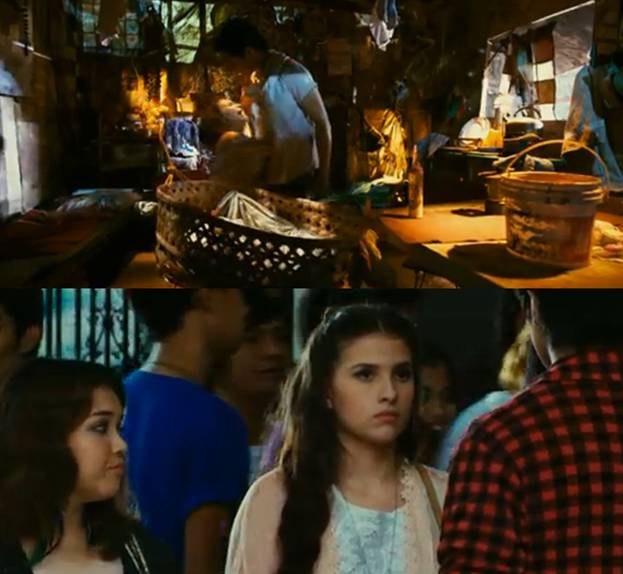
3. Syotang Pa-Class - In an exquisitely choreographed basketball dance, as Rocky describes Tracy, his syotang pa-class, and why he loves her.
4. Awit ng Barkada - Hilarious friendship song with Eugene Domingo, Frenchie Dy and Sweet Plantado
5. Panalangin - In a phone conversation at in front of an altar in a a rundown chapel.
6. Tuyo ng Damdamin - Elaine's contemplative scene comparing her daughter's situation from her own past.
7. Mahirap Magmahal - Coleta's song for his sleeping best friend on the day of their "pamanhikan".
8. Salawikain - Wonderfully choreographed "war at the dining table" scene during the "pamanhikan".
9. Nakapagtataka - On the night after the Polotans storm out from their "pamanhikan".
10. Batang Bata Ka Pa - A four-way song for the heart broken Rocky and Tracy. Rose and Nick join them.
11. Blue Jeans - A buoyant song and dance number at Rocky's university. Sam Concepcion, Neil Coleta and a huge cast dance up a storm.
12. Kaibigan - Brent's ode of affection for the grieving Rocky. John Lapus makes a short but memorable cameo.
13. Huwag Masanay sa Pagmamahal - Used in the closing credits.
14. Ewan - A playful and affectionate duet when Rocky and Tracy reunite.
15.Di Na Natuto - In a adorable scene that helps define Rose and Pol's relationship.
16. Pag-Ibig - Nick tells Elaine to stay with him.
17. Kabilugan ng Buwan - Lovers eloping.
18. Paano - Nick asks Elaine to stay. This isn't the Gary V. hit, but a less popular APO track.
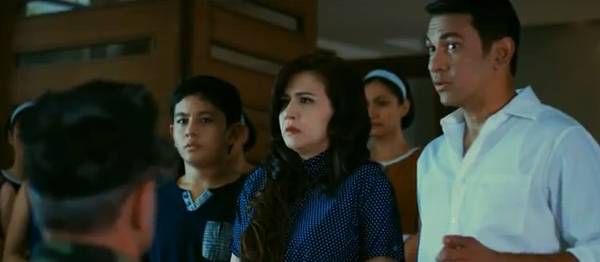 |
| Tracy's gone and the Fuentebellas react. |


