Showing posts with label Zsa zsa Padilla. Show all posts

Monday, December 22, 2014

Jason Paul Laxamana's "Magkakabaung" - A Gem in a Festival


Randy Alcantara (Allen Dizon) lives a facile, albeit joyless life as a single parent to sickly 8 year old Angeline (Felixia Crysten Dizon) in bucolic San Vicente where dust settles on crops and its murky river. Randy is a coffin maker in nearby Santo Tomas where he takes home P285 for a day of carpentry work. A devout father to his child, Randy’s only vice is mischievous town beauty Neri (Chanel Latorre) who mostly takes him for a ride in exchange of phone load and the occasional night out at the cinema. One day, Randy, along with his colleagues, gets hired for an overnighter to rush 60 coffins for a Congressman’s charity project. This will earn him P800 and a day off work thereafter.

Before rushing to work, Randy buys antibiotics (Amoxicillin) for Angeline who’s febrile and coughing, and tells her to take the medicine while he’s out to work. Later that night, Randy comes home to a child who’s barely breathing. He rushes Angeline to the hospital, but it was too late. Fraught with guilt for having given his daughter a drug she’s allergic to, Randy is helplessly unhinged. What’s worse, his P800 salary doesn’t suffice to claim his daughter’s corpse. Where will he get P1,500 to pay the hospital bills?

But like an expeditious reply to his cry for help, Pablo Canda (Emilio Garcia) comes along offering him P2,000, saying “We’ll settle this loan later”. Canda turns in profits by peddling corpses, albeit illegally, to medical schools in need of cadavers. Now, Randy is torn between selling his daughter’s dead body for a P20,000 profit or paying Mr. Canda P10,000 so Randy could finally take home Angeline who now lies in Mr. Canda’s funeral home.

In the morning, Randy makes an unexpected visit to Mabel (Gladys Reyes), Angeline’s biological mother, now blissfully married to an American. He asks for her help so they could claim Angeline’s corpse. Mabel acquiesces. After all, Angeline is her daughter too. But she wants Angeline’s body to undergo autopsy. “Ako na’ng bahala,” she insists. This presents a dilemma for the still-discombobulated Randy who’s aware that he could be pinned down for his daughter’s untimely demise. What to do?


The film tells its story like a slow burn, thus you won't miss any of the salient points the film tries to convey. This richness of ideas thrives within the story: lessons on self-medication; single parenthood; desperation of people who treat corpses like salable commodities; that sending a dead body to a hospital can cost you P2,300; and the anecdote of the coffin maker who eventually ends up making one for his own daughter.

Allen Dizon, as Randy Alcantara, makes a career-best performance that unusually reeks with cinematic paradox, i.e. emotive vulnerability and confidence we’ve never seen from the actor’s previous works. Without any hint of awkwardness we usually find him in (e.g. Joel Lamangan’sKamkam” and Joven Tan’s “Paupahan”), Dizon immersively loses himself in portraying the beleaguered father who may have caused his daughter’s death. His character is adequately entangled in a bind where the harder he tries to extricate himself out of his self-inflicted predicament; the deeper he digs himself a hole. And there seemingly is no light, or ladder if you will, at the end of the tunnel.

Director Laxamana makes adequate use of the region’s local color, giving the film a crisp atmosphere that’s typically rural and a visually fresh scenography. He likewise succeeds using local language to convey a deceptively laidback atmosphere without alienating his audience (i.e. those who don’t understand Kapampangan or are allergic – not just to Amoxicillin – but to subtitles as well). What’s better, his ensemble is a commendable lot: Gladys Reyes, Chanel Latorre, Emilio Garcia, Bor Ocampo and even the comebacking former-sexy star Tonio Ortigas all contribute to a suspenseful cautionary tale. 

Jason Paul Laxamana’s “Magkakabaung” (The Coffin Maker) benefits from the script’s anti-drama swerve, refusing to spiral down into melodramatic sentimentalism despite obvious avenues into the story. Laxamana deftly employs long takes to tell his narrative sequences; a ploy that usually requires patience, precise blockings and time-consuming rehearsals or re-takes. What unravels before you is an organic flow of events - and a very cohesive story telling that’s hard to shake off. Laxamana’s compelling yarn-spinning feels like the perfect delivery of a promise seen in his earlier works, “Astro Mayabang” and “Babagwa”. There are a few misplaced snippets (like the scene showing the “possessed or convulsing girl”) but most of the details harmoniously settle into a fully realized cinematic work. Without a doubt, “Magkakabaung” is my favorite; it is undoubtedly this MMFF New Wave edition’s best picture, and one the year’s finest.

THE REST OF THE MMFF NEW WAVE ENTRIES


While we're at it, you may not want to miss Zsa zsa Padilla's delectable turn as the cancer-stricken, foul-mouthed lawyer Bella Monteclaro in Zig Dulay's  "M (A Mother's Maiden Name)" where Nico Antonio likewise delivers a spot-on portrayal as Joven, Bella's gay son. Dulay's film is peppered with hilarious one-liners that render this film its stab of irony, i.e. to be funny despite its theme tackling morbidity and mortality. Get this: Bella dresses down her secretary with a caustic one-liner: "Mas madami sigurong tanga sa mundo kung hindi mo sinasarili." Nga naman. Or when she says, "Allergic ako sa pretensions. Nangangati ako sa plastic." Or when Bella discusses the essence of real beauty with son Joven and he says, "Ang ganda ay di nakikita sa labas, kundi nasa kalooban ng tao." Bella counters this with, "Yan ang argument ng mga pangit."

The film eventually takes a road trip that uproots Bella to a small town where her mayordoma, Manang Minda (Gloria Sevilla) lives to tend to her sick daughter Liway (Sue Prado). This chapter somehow meanders, but is leavened by scenes involving Joven and a strapping barrio lad named Anton Tumacder, middle named "Malaki" played with flirtatious mien by Marx Topacio and the adorable Nico Antonio who never resorts to thespic excesses common among "screen fags". Yes, not all gays are screaming, flaming fags. Antonio's restrained act smacks of discipline. His performance frames Padilla's acerbic disposition; Antonio's "yang" to Padilla's "yin". And they make a truly complementary pair too pleasant to ignore.  


Arlyn dela Cruz's "Maratabat" is a cautiously made, must-see flick that should remind people of the excesses of power. While Kristoffer King is rightfully sinister as doped out Mayor Ismael, we have trouble picturing his deportment as mayorly, and we require just a hint of this. You get no argument from me though on the fact that he was vicious and scary. His rape scene with Chanel Latorre is particularly jarring, and should not be watered down by mere suggestions. It deserved to be captured on cam. Ping Medina (playing Ronwaldo Maharlika) may have an uncanny semblance to Mr.Toto Mangudadatu, but Medina's performance is compromised by a technical flaw in his delivery of lines - a bothersome breathing technique. His inhalatory excursions are placed midway between sentences, and are thus disturbing. This is most obvious in his speech before his supporters to announce his candidacy as governor of the province running head-on against a sturdy political nemesis Salvador Abubakar (Julio Diaz). It felt like he was going into an asthmatic exacerbation.


We're not quite sure how to "digest" Ma. Diane Ventura's "Mulat" and it's confounding vicious cycle of arguments and counter-arguments about relationships. At some point, it got too exhausting I just wanted them to break up already and just shut their yappers. Take your dose of lithium already, Samantha. One thing's sure though, Loren Burgos is a cinematic find though she needs to work on her "crying technique". You cannot sob away like there's no tomorrow sans tears, unless you have Nasolacrimal Duct Obstruction, but then that's remediable. An ophthalmologist can irrigate on your lacrimal duct for 5 minutes and then you're good as new. If however, for some reason you want to acquire a slice (or two) of tension headache amid lush cinematography, try Ato Bautista's "Gemini". And bring two boxes of super-strength, extended release Ibuprofen with you.   

Guaranteed tension headache.


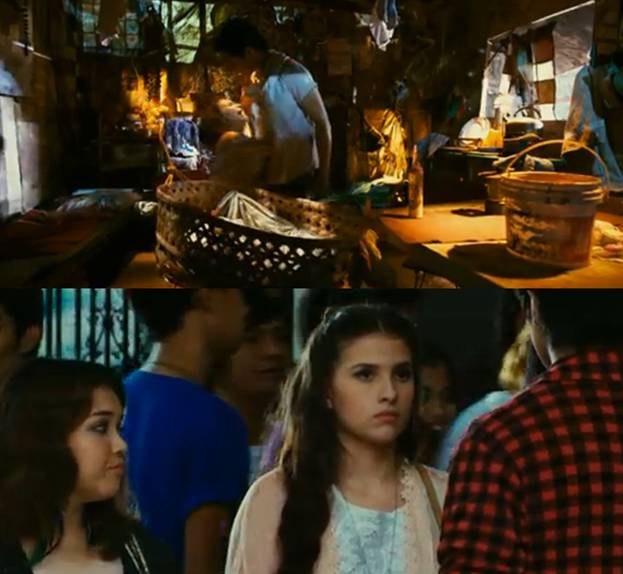
Mabel receives news of her daughter's untimely demise.

Tuesday, February 19, 2013

Emmanuel Palo's A Moment in Time - Charm and Romantic Blunders


The first time Patrick (Coco Martin) sets his eyes on Jillian (Julia Montes) during a train ride, he couldn’t take his eyes off the cautious lass. But getting her name and meeting her were a different matter. The pretty lady is reticent with her associations, keeping mostly to her limited social circle. All she wants is to continue her studies in Amsterdam and forget a rather nebulous past.

Patrick pursues Jillian, painting her likeness on public walls and serenading the girl in her school. With such persistence, Jillian eventually gives in to Patrick’s unabashed romanticism. But unknown to Patrick, Jillian’s past isn’t so isolated from his. The young lad and his sister Mai (Ella Cruz) were orphaned three years ago when their Qatar-bound mother (Zsa zsa Padilla) was run over by a car.

What happens when Patrick finally strings their perplexing past? Will he be as gracious as his courting ways? More importantly, will he be magnanimous?


Emmanuel Palo’s “A Moment in Time” makes a cinematic discourse on the nature of love and its aptitude to exculpate fatal blunders of the past. Coating his artistic canvas with cotton candy scenography, the film is as charming as its leads. Coco Martin, after a sketchy turn in Jerome Pobocan’sBorn to Love You”, succeeds with an imprudent, if disproportionate delineation of a grieving man who pulls out all the stops to woo a dismissive girl who, it turns out, has demons of her own.

It’s refreshing to see a relaxed Coco Martin far from the teeth-gnawing rigor of melodrama. He embellishes his performance with pizzazz, imbuing the screen with wide grins and even a delightful song (Orange and Lemons’ “Umuwi Ka Na Baby”) and dance (oohlala!) scene. Julia Montes displays her considerable gravitas in a performance that becomes one of the greatest suffering heroines of the silver screen. She befittingly complements Martin’s charismatic romcom hero.

The plot is predictable at times, and there are occasional annoying strains in its narrative formation; i.e. once successful in their romantic pursuit, they always end up turning away. It’s a head scratcher really, but formula is what gives the genre its hustle.

It could have been an interesting dissertation following its earlier premise: What indeed is the face of love? But this strain gets forfeited in the narrative ruble. We don't expect mainstream cinema to go further than cursory glimpses beyond philosophical musings.

Plot contrivances are inherent in local romcoms. Regardless, “A Moment in Time” is a harmless entertainment fodder that rightfully bestows a feather in the adorably lisping Coco Martin’s romcom cup. 

As for Julia Montes, this German-Pinay beauty proves to her audience that her irrefutable boobtube success in the teleserye “Walang Hanggan” is no fluke. After all, it’s hard to argue with a full crowd who riddles the cinema atmosphere with romantic giggles. Let’s forget for a few minutes that getting a Schengen visa for a European sojourn isn't as easy – or as cheap as a P180,000 bank deposit - as they’d have you believe. 


Coco Martin bikes around Amsterdam's scenic countryside.


Julia Montes as Jillian Linden: stricken with guilt.

Coco Martin  as Patrick becomes a full-fledged romcom hero. 


Sunday, September 2, 2012

Chris Martinez's I Do Bidoo Bidoo - Rousing and Joyful


Rocky Polotan and Tracy Fuentebella (Sam Concepcion and Tippy Dos Santos) are a young couple who enjoy a loving relationship. But when the latter finds out that she’s pregnant, they instigate a maelstrom of affliction that places both of their families in a quandary. While Tracy’s folks flounder in their affluent milieu, Rocky’s parents are persistently burdened by incoming bills. Pol (Ogie Alcasid), Rock’s father - a musician who has a single hit song to his name – subsists by giving guitar lessons to the children in his neighborhood. He’s mostly frustrated and uninspired by his misfortune. Rose (Eugene Domingo), his wife, struggles with her catering service.

The day the Polotans visit the farm villa of the Fuentebellas for the “pamanhikan” (asking for Tracy’s hand in marriage), the rudely gaping social discrepancy between the two families becomes painfully apparent. While Tracy’s dad Nick (Gary Valenciano) seems to calmly take everything in stride, mom Elaine (Zsa zsa Padilla) is conflicted. She sees a vicious cycle in her daughter – and she doesn’t want Tracy “to feel trapped in a loveless relationship”. At least wait until you’re older, she suggests. But the repercussions of having a child out of wedlock is a nagging concern for the Fuentebellas, and a stigma they’d rather spare Tracy from. “Atin ang babae,” Nick would reason out. Though Rocky is a board certified nurse, he is unemployed just yet. And Tracy’s strait-laced grandfather (Jaime Fabregas), a former military sergeant, isn’t compelled by tact or false civility to keep his thoughts. Over lunch, he unravels them. He does not want Tracy to wed Rocky who does not deserve his granddaughter.

Soon, insults are thrown around and fisticuffs ensue. The Polotans walk out with contused faces and bruised egos. Rocky and Tracy’s impending wedding is unceremoniously called off. What becomes of our star-crossed lovers? Is there happy-ever-after in a musical narrative? Guess.


Syotang Pa-Class
Doo Bidoo

Writer and director Chris Martinez concocts a delectable Romeo-and-Juliet tale by sumptuously utilizing the music of Apo Hiking Society. This cerebral exercise is so meticulously formulated that the songs of a generation – so familiar that they’re almost prosaic, seasoned, and common place – suddenly gain context for a new generation of music lovers. In fact, these songs feel like they’ve been written for the given narrative. Moreover, you cannot deny the timelessness of these musical ouvre. You further realize that these were a few of the songs hummed to you by your father; hymns of a lifetime once played on vinyl records now safely tucked away in some decrepit basement.

What’s more impressive is how Martinez is able to exquisitely insinuate contemporary issues into his seemingly mundane musical romcom: unemployment and the diaspora of the modern immigrants (“Blue Jeans”: Sige kayod sa skwela at balang araw makikita nyo. Pagkatapos ng iyong paghihirap, ‘Di ka rin makakahanap ng trabaho); teenage pregnancy (“Batang Bata Ka Pa” – Nagkakamali ka kung akala mo na ang buhay ay isang mumunting paraiso lamang); class wars, homosexuality (“Mahirap Talagang Magmahal ng Syota ng Iba”), etc. “Blue Jeans” is particularly surprising because the concerns of the 70’s vividly resonate almost 40 years later. It makes you wonder if the lives of that generation aren’t all that different compared to ours. Why do we have similar concerns? Have social conditions deteriorated since the turn of the century?

Sam Concepcion sizzles with an earnest performance that bristles with charm, pathos and urgency. Most singers would have trouble with cinematic emotions, but impassioned Concepcion hits all the right notes! In fact, it’s hard to consider this anything less than a career high. Tippy Dos Santos is a great cinematic find. She’s easy on the eyes, sings like a lark, and tempers her lines with adequate verve and emotive skill. Ogie Alcasid shines in a surprisingly restrained turn. I’ve never considered him in dramatic light, but Alcasid is a revelation here. When he utters: “Kinahihiya mo na lang ako lagi” or “Lahat tayo, kailangan ng inspirasyon sa buhay”, your heart crumbles with palpable affection.

Zsa zsa Padilla utilizes her pent-up frustrations here; a career-best. What I admire most is how consistently she tackles Elaine, a long suffering wife eternally patient and hopeful in a loveless marriage with a hubby who mostly ignores and disdains her presence. Her sedulous take of her character is nothing short of brilliant, and her singing is impeccable. In fact, her “Tuyo ng Damdamin” rankles with regret, you just want to whisk her off her agony. Eugene Domingo balances her fretful Rose with intermittently biting lines that sent me chuckling so loud. We all know someone who nags like that: “Default mode nya yan. Laging galit!” Gary Valenciano is a little tentative with his characterization. He defines his portrayal  with large strokes fit for music videos. Fact is, this is his comeback film after almost 20 years of cinematic hiatus. Fortunately, he enjoys good chemistry with Padilla, so that's a plus!


Awit ng Barkada

I do have issues about using non-singers in singing roles, but Eugene Domingo more than passes muster, although she could have done a wee better in her “Di Na Natuto” duet with Alcasid. After all, paying homage to the songs of a generation includes singing these songs beautifully. When, Dame Judi Dench, for example, performed “Send in the Clowns” for her role in Sondheim’s wistful “A Little Night Music” at the Royal National Theatre in London, it was heartfelt, but I helplessly looked for the beautiful melody. Melodies deserve to be sung as they were written, not recited into a half-song. Anyway, Dench won the Olivier that year. Domingo is clearly inspired, and it shows. Her “Awit ng Barkada” number with Frenchie Dy (as BFF Lilibeth) and Sweet Plantado (as BFF Vicky) was a touching tribute to friendship, I had to control myself from shedding a tear because – heck! – the scene wasn’t schmaltzy! But you see, beautiful numbers just make me cry (dramatic or otherwise).

A considerable, albeit bittersweet side story involves Neil Coleta’s Brent, Rocky’s closeted best friend who’s in love with him. Though his scenes inadvertently provide humor, you can’t help but be taken by Brent’s emotional impasse. This narrative string is so beautifully written, it deserves a separate movie of its own. In fact, I am urging all the Pink Film makers to turn their attention to this film for inspiration! This short narrative detour amounts so much more than all of the Pink Films shown in 2011 combined! It is funny, empathetic and insightful. It doesn't paint the gay man as hormonal, albeit sexual predators possessing the brain of a Hydra! An important scene here involved John Lapus shedding a tear while Coleta dedicated his “Kaibigan” song to Rocky – at a videoke bar! This understated and wistful vignette was a perfect finishing touch to a cinematic Mona Lisa. It was just beautiful!  

The narrative isn’t seamless. It’s guilty of “fast resolutions” common in romcoms. It could have invested a little more time to write the gradual resolution or settlement to Rock and Tracy’s dilemma, but then I understand the limitation of time allotted for such flicks. In fact, I think I saw “Paano” in the credits, but the scene involving it didn’t make the final cut. Needless to say, one of my favorite numbers was the “Blue Jeans” dance routine involving a huge crowd in La Salle Dasmarinas. It was just kinetic, and reminded me of some scenes from Jeric Soriano’sHotshots” (which also starred Gary Valenciano).   

HOW APO DEFINES FILIPINOS TO OTHERS

We are a very musical nation. I remember my traveling cousin relate an anecdote about a Canadian backpacker he met in Vietnam last February (2012). The Canadian guy has a Filipina girlfriend who would take him to karaoke nights with fellow Filipinos in Vancouver. His favorite: “Ewan”! And just before my cousin could dismiss this as pure hearsay, this white man suddenly lurches into “Mahal kita, mahal kita, hindi ‘to bola…” This is a guy who doesn't have clue on who Danny Javier, Jim Paredes and Buboy Garovillo are. Yet their musical legacy encompasses race and geography. Who can say that the APOs are mere historical anamnesis? We deserve our songs encapsulated and documented in films like “I Do Bidoo Bidoo”. These songs tell our stories, and we can only be grateful for the endless pleasure they bring.

Chris Martinez’sI Do Bidoo Bidoo: Heto nAPO Sila!” is a mirthful musical masterpiece that’s as rousing and hopeful in temperament and narrative exposition as the songs and stories of our lives. It deserves the patronage of every music-loving Pinoy. It should not be missed!  


Trading aphorisms in "Salawikain". Lalalalalalalalalalalalalala...

Contemplative Elaine sings "Tuyo ng Damdamin".


Songs featured in the movie:

1. Pumapatak na Naman ang Ulan - A recurring tune and Pol's one-and-only hit song!
2. Doo Bidoo - Cheerful number involving Ogie Alcasid and her guitar-carrying wards.
3. Syotang Pa-Class - In an exquisitely choreographed basketball dance, as Rocky describes Tracy, his syotang pa-class, and why he loves her.
4. Awit ng Barkada - Hilarious friendship song with Eugene Domingo, Frenchie Dy and Sweet Plantado
5. Panalangin - In a phone conversation at in front of an altar in a a rundown chapel.
6. Tuyo ng Damdamin - Elaine's contemplative scene comparing her daughter's situation from her own past.
7. Mahirap Magmahal - Coleta's song for his sleeping best friend on the day of their "pamanhikan".
8. Salawikain - Wonderfully choreographed "war at the dining table" scene during the "pamanhikan".
9. Nakapagtataka - On the night after the Polotans storm out from their "pamanhikan".
10. Batang Bata Ka Pa - A four-way song for the heart broken Rocky and Tracy. Rose and Nick join them.
11. Blue Jeans - A buoyant song and dance number at Rocky's university. Sam Concepcion, Neil Coleta and a huge cast dance up a storm.
12. Kaibigan - Brent's ode of affection for the grieving Rocky. John Lapus makes a short but memorable cameo.
13. Huwag Masanay sa Pagmamahal - Used in the closing credits.
14. Ewan - A playful and affectionate duet when Rocky and Tracy reunite.
15.Di Na Natuto - In a adorable scene that helps define Rose and Pol's relationship.
16. Pag-Ibig - Nick tells Elaine to stay with him.
17. Kabilugan ng Buwan - Lovers eloping.
18. Paano - Nick asks Elaine to stay. This isn't the Gary V. hit, but a less popular APO track.


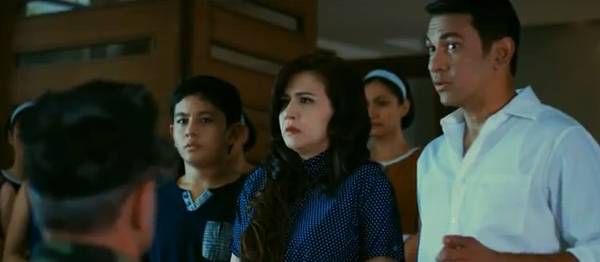
Tracy's gone and the Fuentebellas react.


Friday, December 30, 2011

Joel Lamangan's Sigwa – Raging Storms and Troubled Souls


It took Dolly (Dawn Zuleuta) 35 years to return to the Philippines. Back then, she was a wide eyed optimist visiting her parent’s motherland for the first time. She also believed that well meaning people like her could fight a feeble system and change the world. Several years later, she has returned for a more compelling reason; one that took her back to that tumultuous era. In the early seventies, she hurriedly escaped the clutches of Martial Law quite scathed and dazed, leaving a daughter under the care of Azon (Gina Alajar). In the crossfire of warring ideologies, many have perished. Including her child, or so she thought. But a common friend recently tells her that the child is alive.

At the height of an oppressive dictatorship, young idealist Dolly (Megan Young) – a junior correspondent of a US magazine - is welcomed by a group of student activists who ushered her into the ideals of their advocacy. She meets student leader Oliver (Marvin Agustin) and his girlfriend Cita (Pauleen Luna); the persevering Azon (Lovi Poe) and the dependable Rading (Jay Aquitania); then there’s the restrained Eddie (Allen Dizon) with whom Dolly gets into a relationship. With adequate fervor and high-mindedness, the group soon finds themselves joining the underground movement bent on toppling an oppressive government.

But each member is deliberately captured. The ladies are raped; the guys are subjected to hellish tortures until their souls have all been beaten to a pulp, providing names and whereabouts of their other comrades. Meanwhile, Dolly’s been recovered by the authorities who have been informed that she’s an American citizen, giving her the privilege to abandon her group’s cause and fly back to America while everyone else faces a bleak future.

But 35 years have changed people. Dolly has chosen to live a solitary life. Oliver (Tirso Cruz III) has joined the government, acting as the presidential spokes person, while Cita (Oliver’s former girl friend, this time played by Zsa Zsa Padilla) has risen in the ranks of the left-leaning revolutionary group. She has in fact become their supreme leader. Dolly has required the help of Oliver, now in the position of finding people, to locate Azon (Gina Alajar) who was left with Dolly’s child at the height of the insurgency. Dolly’s pursuit has unraveled strife anchored by their past. Is her daughter still alive? Will she ever find her?


Joel Lamangan’sSigwa” (Storm) is a harrowing journey that follows the lives of student activists with ponderous tenacity. On the foreground is a mother’s search for her child, but it’s merely a device used to introduce us to the characters. Though compelling and thematically clamorous, the focus wavers from too much detail. This isochronous storytelling tends to provide a less cohesive work, denying the material to soar. That’s always the plight of a material with a multitude of climaxes, thus the story eventually plateaus. This is not saying that Lamangan’s “Sigwa” is an insignificant material. It in fact deserves to be seen and remembered.

Megan Young and Dawn Zulueta competently link the past and the future with honest portrayals as Dolly. Marvin Agustin delivers one of the most emotionally distressing depiction of a torture victim. While his tears trickle down his cheeks and he pleads for his life, you are punched in the gut by the scene’s realism. Tirso Cruz III, who plays the older Oliver, is equally treacherous as the cabinet secretary who’s had a change of heart. Gina Alajar, brilliant as ever, mines her veteran instinct to show the emotional groundwork of a mother who’s afraid to lose a child she’s nurtured as her own. I do have certain misgivings in Zsa Zsa Padilla’s portrayal. Maybe I’m too much weaned on her being the sophisticated lady that she is that it doesn’t seem right to see her carry guns and don sneakers, and tough talking like a revolutionary honcho. But she works hard for her part and it shows. Allen Dizon seems misplaced and looks awkward and ill at ease in many of his scenes, and the age gap between Megan’s Dolly and Dizon’s Eddie (he was planted by the military to spy and infiltrate the leftists) is a lumbering fact.


The torture and rape scenes feel sanitized. The sense of dread is somehow watered down by its careful staging. In my mind, there’s a need to stage a brutal scene – allow it to be ruthless and ferocious - to underline the horrors of an amoral military rule gone mad. Torture victims are scarred for life, and they don’t experience savagery with cotton candy ministrations. Despite its busy narrative, fragmented storytelling and its tendency for maudlinism, “Sigwa” is better realized than the indulgent “Ka Oryang” (which won Best Picture at the recent Cinema One – a truly despicable year for the festival).

A favorite scene is Dolly and Azon’s meeting. In this scene, the camera frames a troubled Azon – with Alajar in tremendous control – while the light from outside is casting shadows against her face. It was a deliberate form of visual poetry concocting a singular emotional moment that highlights Azon’s chagrined soul. Are there limits to what a mother would do to keep a daughter? Boundless.


Saturday, July 26, 2008

Couch Potato Tears

After placing a measly 3rd place at ABS-CBN’s Little Big Star talent show, Charice Pempengco’s mom prods her not to cry where everyone can see. Once inside her dressing room, Charice turns to her mom and pleads, “Puwede na po ba akong umiyak?” Her mother looks at her daughter, nods, and says, “Sige, pwede na. Pero sandali lang ha?”

And I thought I wasn’t gonna cry! (This, for being such a couch potato today!)


MMK episode "Ice Cream"
Some dreams take a million cones of ice cream.