Showing posts with label mark gil. Show all posts

Thursday, February 20, 2014

Gabby Fernandez's "Mana" - The Stalling Game


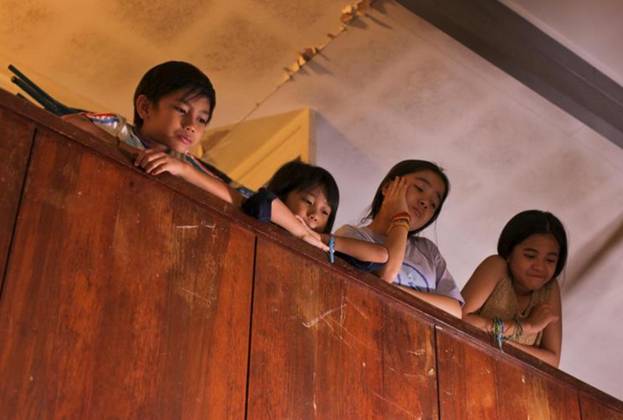
News of Doña Concha Villareal’s worsening illness is spreading like wildfire across the sugarcane plantations of a quaint town in Negros Occidental. The once invincible matriarch (Fides Cuyugan-Asencio) of the Villareal clan is in fact confined to her sick bed, spitting blood, spending her waking hours wailing from excruciating pain. This has been a familiar scenario in the last couple of years. Fearing her impending demise, her children rush home. A salient matter needs to be settled soon before it’s too late. But everyone seems to be stalling.  


Rolly (Jaime Fabregas), the eldest, refuses to take the cudgels of the clan’s dilemma. He has been overseeing the hacienda’s operations for the past two decades. Meanwhile, Sandra (Cherie Gil) takes a sabbatical from her world travels to see her mother. 

Her twin Lino (Mark Gil) has taken to the booze to dull out bothersome visions. Mike (Ricky Davao), on a hectic campaign trail for the town’s mayoralty, is taking advantage of the choleric situation to gain publicity (or sympathy) before a concerned electorate. Half-sister Ces (Tetchie Agbayani), tasked to take care of the ailing matriarch, is on the throes of giving up her chores. Successful interior designer Bernie (Epy Quizon) takes his sweet time to head back home which he abandoned a few years ago. 


But time is ripe; they need to gather around to deal with a precarious situation - the bequeathing of a legacy, a family secret that would redefine the influential clan’s role, not to mention turn their briskly dwindling influence around, in a town steeped with tradition, political undertone and superstition.  
   

Director Gabby Fernandez deftly captures the old-world grandeur of a diminishing oligarchy as he endeavors to examine the intricate mechanics in an upper class family, once mighty and beloved. After the demise of its patriarch, Don Manuel (Leo Rialp), the Villareals' clout is gradually fading. Fernandez wastes no time recreating the delectable world of haciendas and sakadas, taking his viewers to this near-forgotten era of feudal lords and subservient tillers.

The film benefits from the glossy camera work and the perfect setting, allowing the viewers a glimpse of that glorious era of sugar barons and their rolling fields of greens. If you're familiar with those century old mansions of Silay and the surrounding communes of Talisay, then you know what a treat it is to have them "captured" on film. The opening scene alone is a virtual "slide show" framing the story of this once powerful clan, now a spasmic cluster of souls who just want to break free from a seemingly stifling family tradition.

On point of performance, Cherie Gil is a breath of fresh air amidst a flurry of downbeat characters caught in their own personal upheavals. Unlike every one else, she seems to be the only one genuinely happy to see her siblings again which is odd. True, these are some of the most competent actors in the business, but the complete thespic plenary tilts towards being heavy handed, an artifice designed by the story teller. Is this pre-meditated, considering how the story eventually unravels in the end? Maybe so. But something in the narrative structure suffers. When the magĂștud find themselves in a quandary, over something that is never revealed until the last 15 minutes of the story, they puff away in cigarette heaven. It was becoming droll. As earlier mentioned, most of the allegory stalls, giving us the impression that this narrative buffering has something more explosive than the death of the matriarch. Mostly though, it's a long painful wait.

The impasse in the story is dragged down by its glacially paced retelling. In fact, 40 minutes into the story, nothing was happening. The plot was headed nowhere and the story arc seem to have flatlined. The characters spoke in riddles and the requisite confrontations soon turn into awkwardly blocked theatricalities that eventually bored the shite out of me. At this point, I was tapping my heels impatiently. One hour and 15 minutes later, I was still looking for clues. What was the darn conflict? Why were there images of pernicious evil - church manangs cloaked in black; cryptic writings on the wall ("You promised you would make it easy for your mother..."); a dog with shifting color and luminous eyes; a child who speaks to an apparition; voices in the wind, etc. Is this moving beyond the legal implications of primogeniture?

Assimilating the concept of the aswang ("shapeshifters") with the realm of the hacienda-owning Visayan upper class is a savory affair. After all, the region is replete with folkloric creatures like the blood-sucking sigbin, the night-prowling wakwaks, the cigar-smoking Agta (left), the fire-spewing santelmo, the ungo, etc. The regions of Luzon aren't this rich, are they?

Trouble is, a certain degree of urgency is vital when you're laying down "monsters" on your cinematic platter. You don't get the necessary effect based on mood or atmosphere alone. The dramatic showdown, i.e. the confrontation scene, felt too wayward and misplaced because, frankly, the audience's window of attention or interest has long passed on and expired. When the siblings are finally standing in front of their dying mother's sickbed, I couldn't help but heave a sigh of relief. It was high time to move the story, instead of forever stalling it for a rousing, albeit explosive climax that didn't quite arrive. When Fides finally feeds Cherie the monster's stone (think Darna passing on her "bato" - her stone amulet - to a successor), the scene settled into one lukewarm tableau. Uh, okay, that was the inheritance. Right. Next, please.

They all wait!

And they wait again!


Old world charm of the affluent Negrense.


Friday, August 3, 2012

Chito Rono's The Healing - The Sick, The Dying & The Doppelgangers


Like many people who get frustrated by the limitations of medical science, Seth (Vilma Santos), an insurance executive, takes her ailing 74 year old father (Robert Arevalo) to Manang Elsa (Daria Ramirez), a renowned faith healer. After some incantations, they were sent home with a medicinal concoction for her stroke patient. To her surprise, the next day finds the old man completely rid of stroke – strong, ambulatory and even virile! Tatang is given a new lease in life. And he starts living his days like they were his last. News travel fast. Soon, Seth’s house becomes an infirmary of sorts, with her circle of friends gathering and seeking her help for a coterie of complaints: a breast mass, diabetes, psoriasis, pediatric blindness, etc. Would Seth – pretty please – accompany them to Manang Elsa? Heck, even her ex-husband’s daughter Cookie (Kim Chiu) is afflicted with kidney disease, and she's gradually wasting away!

Seth takes her friends to the healer, but Manang Elsa refuses to see anyone. “May sakit s’ya at tumigil na s’ya sa panggagamot,” explains Melchor, Elsa’s son. They refuse to leave the shaman’s house. A lot is at stake: a medical clearance for work in the Middle East; an approaching wedding; a life free of cancer, etc. The old woman finally acquiesces and accommodates her assertive visitors. Everyone goes home hopeful, but few of them remain skeptical. One by one, Seth’s friends experience the miracle of healing - breast lumps disappear, gangrenous feet clear up, and blood sugar normalizes! Elsa was wrong, Ate Guy! “May himala”, indeed! Even Cookie’s blood dyscrasia and sallow skin clear up like magic! Everyone rejoices.

Then Seth starts seeing crows that appear incommodiously. She also sees doppelgangers of her friends; body doubles devoid of emotions. Then chatty Chona (Ces Quesada), who has always been good natured, turns amok. Is her strange demeanor related to the healing? Would it affect the other “patients” as well? Why is Seth’s father – the first to be treated – unaffected? 


The movie is an ensemble piece, held together beautifully by Vilma Santos though it’s easy to see it’s a walk in the park for the Star for All Seasons. It's a welcome respite to see Santos in a genre far removed from her bombastic dramas. I am a wee bit distracted by her “look” – she looked like our favorite Batangas Governor: thick rimmed glasses, corporate blouses, etc. I understand that she plays an insurance executive, but there has to be a difference between an insurance peddler and a governor, right? But I’m merely nitpicking. Santos is nevertheless a joy to watch.  

I am seeing Kim Chiu in a new light. This is a more adorable Chiu, devoid of her woe-is-me demeanor. She plays the sympathetic stepdaughter afflicted with Glomerulonephritis. Glomeru…what? It’s just a kidney infection, my tita said, who further shared, “We admit cases like that left and right. They’re easy to treat – like UTI - and could be managed as an out-patient case. So it’s weird hearing it as a fatal disease entity.” Sus, I thought it was analogous to a death sentence. J  But back to Kim, she was reasonably compelling. When she suddenly asked Seth, “Galit po kayo sa akin, Tita?” my heart went out to her. I wish Kim’s succeeding projects wouldn’t lay on the melodrama too thick, then I’d be happy to watch her again. In “The Healing”, Kim Chiu eschews an adequately fleshed out character.


SPOILER ALERT!

The rest of the cast should be proud as well. Martin del Rosario (Seth’s son and Cookie’s half-brother Jed) displays a strong cinematic presence that should guarantee him more screen work in the future. Other note-worthy portrayals include Janice de Belen as mother Cita, Joel Torre as Melchor (the healer’s son), Daria Ramirez as Elsa (the faith healer), Robert Arevalo (Seth’s father), Mark Gil (Seth’s former husband), and Pokwang (as Dubai-bound Alma). I am conflicted with Jhong Hilario’s participartion: his wig looked nasty (and fake). Dario, his character, got electrocuted. When he was taken to Manang Elsa, he was already dead. The healer went on to resurrect the dead which should be a taboo, for obvious reasons. And such action necessitates the claiming of another in exchange of Dario’s. Quite a valid scenario, if you ask me.

DOPPELGANGERS

In folklore, doppelganger – the paranormal double of a living person – typically represents misfortune or evil. These entities are a form capable of “bilocation” (St. Pio de Pietrelcina was said to have had such power), but in this light, they are harbingers of bad luck, and may portend illness or an accident. It can be an omen of death. The idea of doppelgangers exists even in Norse and Finnish mythology as well as in the Ancient Greeks and Egyptians. A popular poet, Percy Bysshe Shelly told his wife how he met his doppelganger. Few days later, the English poet drowned in a bay in Italy. Other historical persons who died after meeting their doppelgangers include Abraham Lincoln and John F. Kennedy. It is interesting therefore to encounter the Pinoy perspective on doppelgangers, violent creatures in Rono’s re-imaginings.  

One of my favorite scenes involves the monks at a Buddhist Temple. Since this scene is not exactly commonplace, the praying monks imbue it with a sense of mystery. Rono is quite good with employing local color that, as an audience, it’s easy to immerse oneself in the make-believe world we are witnessing. 


Director Chito Rono has created a feasible scenario that hooks his viewers from the start. After all, we have a rich and inherent tradition of interweaving faith, superstition and medical science. But what makes “The Healing” unsettling is its distinct plethora of events: patient gets healed; crows loom; doppelgangers appear; the patients crack up and go berserk, then turn amok.

In the narrative, chronology of events takes center stage to exploit paranoia and a rankling of supposition, not dissimilar to the “Final Destination” movies. Who follows whom? How will they perish? And Rono concocts this atmosphere of morbidity with inspired compulsion and rabid vehemence. When Ynes Veneracion leisurely saunters towards the concrete with a giant chopping knife while her husband (Allan Paule) stoops down at the center of the road, you want to hit a pause button. There was a chill running down my spine. You know what’s coming – and you watch in frustration until the deed has been consummated! Rono keeps his narrative clamorous all throughout.   

 The Healing” is experiencing a slow burn – “a fuego lento”. In fact, it is doing an amazing business in its second week. In three different mall cinemas this weekend alone, I saw queues mostly meant for “The Healing”. This is good news for mainstream cinema that has suffered a considerable plunge in theater attendance from January to June 2012. Word of mouth sure works like magic.    


Friday, March 16, 2012

Corazon: Ang Unang Aswang – Horror vs Lunacy


Daniel and Corazon (Derek Ramsay and Erich Gonzales) are an impassioned couple living their rustic lives in war ravaged Magdalena, a town where the preponderate fist of feudal landlord Matias (Mark Gil) rules. The latter’s occasional incursion is generating whispery hums of uprising from the barrio folk. While Daniel is a welcome presence, Corazon – a radiant beauty – is scorned by the gossipy women. Despite Corazon’s dainty demeanor, she bears the stigma of her departed mother believed to have had contentious sexual alliances with American and Japanese soldiers. But the people’s constant derision is not the least of Corazon’s concerns. After five year of marital bliss, Corazon remains childless; and the couple is getting desperate for a child.

One day, Corazon visits a hilot (Maria Isabel Lopez) notorious for performing unorthodox rituals and orasyons. She lends the statue of San Gerardo, the patron saint of expectant mothers, with very specific instructions: take the statue to a quiet place on a hill where, for a week, the expectant mother has to stay there and pray on the saint from dusk until dawn. Corazon did so and not long after, she starts infanticipating.


As land disputes heat up in Magdalena, Matias’ staunch critics start disappearing – and dying! But instead of turning to the despotic landlord, the barrio folk turn to a wandering lunatic named Melinda (Tetchie Agbayani) who has a reputation of being a witch. While defending Melinda from a violent crowd (Melinda was eventually killed, but not before she throws a “curse”), blood streams down Corazon’s legs. Did she lose the child?

The succeeding scenes show Corazon carrying her child to term. But when she gives birth, it was stillborn. The impact of their loss takes a toll on Corazon’s sanity as she refuses to bury her dead child. She carries the corpse around town to the consternation of the people who loathes her from the start. One day, Corazon raises the child and shouts to the heavens seeking retribution to her God: “Isasama ko ang aking anak sa aking paghihiganti sa Inyo!” Then she starts gobbling up until every morsel of flesh is consumed. Having crossed the dark line, Corazon is consumed by her craving for flesh. She soon hunts for live animals and eats them. When those didn’t suffice, she turns predator to the children of her barrio. Body count piles up and fear envelopes the land.

Daniel meanwhile is desperate to find his straying wife. His neighbors speak of tales alluding to Corazon and the disappearances of children in town. But Daniel is aware of a few things involving Matias and his gun-toting henchmen. Will he ever find Corazon before the people get to her?


Director Richard Somes is back with another Cimmerian tale that has become his trademark, and we were quite excited with “Corazon: Ang Unang Aswang”, a brave revisionist take on the genesis of the folkloric “aswang”, a Philippine mythical ghoul. "Aswang" has captured the imagination of international film makers like Wrye Martin and Barry Poltermann’sAswang” (1994, shot in Wisconsin, and had an entirely American cast) and the South African film “Surviving Evil” (directed by Terrence Daw, 2009) starring Billy Zane, Christina Cole and our own Joel Torre.

UGLY

But what promises to be an immersive cinematic experience turns out to be an ugly film! Yes, ugly! The narrative elements are anarchic and sometimes, even aimless. Let’s take the character of Melinda, played by a ridiculously wigged Tetchie Agbayani. She was supposed to embody the powerful witch who curses the capricious crowd; the same crowd who discriminates her. Yet her “spell” didn’t even seem related to the cataclysm affecting the town. Another character is the hilot played by Maria Isabel Lopez, initially introduced as someone who performs dark incantations which turn out nothing more than devotional prayers to St. Gerard. Nothing is sinister by praying to a saint, is there? In fact, after one scene, Lopez disappears forever.

SIN OF COMMISSION

The most blatant sin of commission is the promise of horror, of evil. But Somes and co-scriptwriter Jerry Gracio seem befuddled – and even disoriented - with the concept of “insanity”, confusing it with a notion of pernicious evil. Since when are “insane people” considered “aswang”? Because if we were to really accept such reckless ideation, then we should all troop down to the National Center for Mental Health (Mental Hospital) and burn all their patients at the stakes to get rid of “aswangs”, debah? Schizophreniform disorders should never be construed analogous to the folkloric “aswang”! These items are poles apart! Or are Gracio and Somes suggesting that “aswangs” – with their vampiric appetites, pointy nails, overly long tongues, and winged forbearances - are mere psychiatric predicament? Nahihilo kayo, ‘te?


POSITIVE POINTS

The film barely comes up with positive points: 1) a sumptuously dazzling cinematography (Hermann Claravall) – sun kissed summery scenes that reek with atmosphere; interiors and night shots with impeccable clarity; absolutely one of the most gorgeous camera work we’ve ever laid eyes on; 2) Mark Gil plays the nefarious haciendero with exact temperament; 3) the luminous Erich Gonzales who glistens in insightful splendor and subjugated emotional engagement. Her beauty and calm confidence cajoles the intermittently irritating narrative strain. Gonzales absolutely commits to her physical stipulation that her utter obedience is nothing less than eloquent. Unfortunately, even Gonzales’ brilliance is not enough to save a farcical, harebrained narrative.

UNEVEN PERFORMANCES

The film is further hobbled by an uneven performance of majority of its cast which is characterized by exasperating histrionics (Sue Prado), overtly unregulated methodic role playing (the irritating Bodgie Pascua displaying to his adoring Batibot audience how it is to cough while eating and speaking – which is real talent); undue comedic delivery (Mon Confiado plays Berto; when he sees the “aswang” at the foot of his bed, he shouts “Ay aswang! Kamukha yun ni Corazon ah!” – the audience roared with laughter); rough vocal switches (Tetchie Agbayani as Melinda would hiss and growl like an animal, then just as easily revert back to her school-teacher speaking voice); the blank facies of its amateur extras. Then there’s Derek Ramsay whose emotional undertaking is displayed by his “smoldering gaze”. He’s angry – he smolders! He’s sad – he smolders! He’s disappointed – he smolders! He’s heartbroken – he smolders! Heck, if he smoldered more than he did in “Corazon”, he might as well turn into an igneous rock! Couldn’t the fantastic actress in Angelica Panganiban infuse a degree of role playing emotionality to Mr. Ramsay? Some tutorial in acting perhaps?

ERRONEOUS BILLING

And why on earth is Derek Ramsay billed ahead of Erich Gonzales? Appearing in last year’s biggest blockbusters - “No Other Woman” and “Praybeyt Benjamin” – doesn’t necessarily make him more superior than Erich Gonzales in seniority or artistic capability. Neither was he the box office draw from the aforementioned films. People didn’t watch those films because it had Ramsay in them, heavens! Now he’s posturing with seductively understated threats as though he might as well move to TV-5 which didn’t exactly do wonders for Nora Aunor, Sharon Cuneta, Maricel Soriano, Dolphy and Aga Muhlach. What big movie did TV-5 produce – “Rosario”? That was 2 years ago! “Yesterday, Today, Tomorrow” was a tail ender and an artistic turkey at the recent MMFF box office race. More importantly, this movie is titled “Corazon Ang Unang Aswang”, not “Daniel: Ang Asawa ng Unang Aswang na Lukaret Lang Pala”! I’d say, let him move alongside talents like Arci Munoz, Alex Gonzaga, Eula Caballero, Danita Paner and Carla Humphries. He wouldn’t look too lost with them.

MAGIC MAKE-UP, MAGIC HAIR

And then there’s the “here today, gone tomorrow” eye make-up of Corazon. When she’s feeding in wild abandon, the black and round eye shadows are thick and dark. When she speaks, these orbital discolorations almost disappear! Like magic! Is that the power of an “aswang”? LOL. In one scene, Derek and Epy find strands of hair beside the tree where Corazon ate her baby. “Kay Corazon ‘to,” they said. I stood and proudly declared, “It’s mine!” I was pulling hair in sheer disgust!

Bodgie Pascua distractingly coughs and eats and speaks for his Famas moment!


Wednesday, February 8, 2012

Tahanan - Sappy and Shallow in Crapland


As part of her class assignment, Samantha Benitez (Lauren Young), a 22 year old student, must undertake a two-month immersion at an orphanage. In the program, she has to live and help out in the activities of the orphanage called Bahay Kanlungan. Though initially cautious of her acquaintances, Sam gradually warms up to the motley characters that populate this subcommunity of disavowed children. Sam is also introduced to the dedicated Mama Precy (Angelina Kanapi), one of the foster mothers. Precy stays with the children 4x a week. But unknown to the children, Sam’s earlier animosity roots from a domestic issue: her mother abandoned the family for another man. She hasn’t heard from her mother since.

The orphanage is home to 12 children, but she is drawn to three of the kids: there’s Kyla (Sabrina Man) who treats her like a big sister; Rey (Miguell Tanfelix) whose father is preoccupied attending to his bed-ridden mother; and sprightly Efren (Khen Aldovino) who has trouble staying in school. Sam would eventually get emotionally attached to the children. One day, she receives word from her dad (Mark Gil) that her mother has returned, but the latter lies comatose at the hospital. Why should Sam care? She abandoned her, didn’t she?


Among the three entries from this year’s Big Shot Filmfest, Krizzie Syfu’sTahanan” was the most messy. It is blotchy in presentation, not to mention exceedingly zealous where emotionality is concerned. Everything is loud and unfettered. Not only were the characters reflective of overdrawn depictions, they were also excessively overeager in temperament. In short, “OA na OA!” Angelina Kanapi, for example, keeps forgetting that this isn’t a comic material where she could just ham it up and resort to her scene stealing afflictions – as she does in every single film she’s in. Listen to her prayer, you’d think she's a stand-up comic standing before an Apollo Theater crowd. She would speak in high sing-song pitches, then suddenly latch into clipped giggles, as though an orgasm is briskly underway while she was serving lunch. It’s unnerving. If she’s out of the frame, their other foster mother Myrna takes the “stage” with her high strung demeanor. And you wonder why the children are so effed up?

Lauren Young delivers a perfunctory performance from an otherwise mediocre script. She barely buoys a briskly sagging narrative. Fact is, Young is a gifted performer and she never resorts to brimming sentimentality, but there's so much one can do with a trite script and an even dour characterization.


When cloyingly adorable Kyla confronts Sam, the once-clingy and delightful teenager suddenly morphs into a cantankerous bitch from hell, spewing acid like a possessed soul. And everyone just stares at her. No one even dared to stop her from her constipated bravado, not even the authoritative figure in the room – Mama Precy. They were just frozen stiff. Why is it so hard to understand Sam’s dilemma? Her mother is on death’s bed, for pete’s sake! Even a 6 year old would be able to discern the right thing to do! Then there’s the ever annoying Efren – Khen Aldovino – who is prone to acting out like an overcharged version of a clown! Most times he’s in front of the screen, he behaves like an amused epileptic, I just wanted to throw darts at the screen.

When the action turns to Sam’s scenes at the hospital, the movie shifts to a different film altogether. The sense of disconnect is so palpable, I suddenly missed watching MMK. You then realize the unfocused attention of a film maker who: 1) is clueless on thespic executions, thus she is ill equipped to direct her actors, 2) cannot tell a legible story without resorting to unnecessary, albeit protracted detours, 3) drawn to melodrama – and not even succeeding to a coax a single tear from her audience after all the incessant caterwauling!


SUPPLEMENTARY ANNOYANCES

While I was watching, 5 rows ahead of me were two ladies freely discussing the film, oblivious to the rest of the paying crowd. For the duration of this painful experience, you could hear them annotating scene per scene what went on during the filming. One would say, “Naka ilang take kami dyan.” And so on. So it’s safe to refer to these dingbats as part of the production team.

This begs the question: Isn’t cinema etiquette taught in their university (DLSU)? Did they think they were immune to good manners by chatting up overtime like they were in their own story conference? Such uncouth behavior from the makers of the film itself makes you wonder why they can’t even render due respect that their film required. I began to comprehend why. Because they knew they were in crapland! And only still waters run deep!

So they kept making noise!


What's with film graduates from New York Film Academy? This is the second disappointing work we've seen from an alumnus of that institution.


Khen Aldovino needs restraint... or medication... or electroconvulsive therapy! He was distracting and annoying!


Lauren Young: insightful


Miguell Tanfelix reminds me of Derick Monasterio


Thursday, January 14, 2010

Puntod - Chronicles of Agony


Cesar Apolinario's "Puntod"is 2010's very first Filipino movie offering! Having mentioned that, we expected a lot from this digital film. But whatever promise it has is foreshadowed by its English title - "Baby's Tomb" - which spells grief, grief and more grief! From the get-go, we had an inkling of how the story would end. The main character is a lachrymous mute named Baby (the pretty Barbie Forteza), who scavenges for scraps and left-overs to earn money.

Baby should eventually die. Otherwise, she wouldn't possess a tomb of her own, right? Right!

Spoilers!

But the narrative that leads to her demise is a convoluted headache of a story rife with heartaches (her mother was run over by a jeep; her father is blind; her well-meaning friend/teacher gets raped; her close friend gets shot) and abuses (her older sister is a bitch of a witch who shrieks to high heavens from dawn til sundown). Then from out of the blue, an awkwardly sequenced anti-climactic shootout ensues that came out of nowhere! But wait! It didn't end there. It couldn't - since Baby was still walking, and don't we expect her lying in a coffin - stiff and cold? Well, that eventually happened! Thank heavens.

Forteza is appealing, but she is mostly misdirected. Her scenes are a continuous montage of annoying cries and sobs and wails. I barely succeeded hanging on and staying put, and finishing the film that felt 3 hours long! No, sir, it's just 1 hour and 10 minutes or so, but it felt like a bundle of sacrifice. On the plus side: Mark Gil's Mang Delfin is engaging; and there's a crisp and luminous cinematography!

But the performance of note was turned in by Sheree. She was shrill and an annoying cardboard-cutout! I wanted her ejected out of "Puntod." She should star in another movie all her own - a movie that I won't be too lucky to pay P160 for! (Nilagnat po kasi ako eh!)